In the blog ‘why everything breaks when you reach 25 employees’ sheds light on dealing with company growth challenges, such as unable to manage everyone yourself and employees are not aware what is going on anymore. The two learning objectives we came up with are:
LO 1: What are the roles of human resources in a growing company?
LO 2: How can internal processes help a company gain competitive advantage?
Key words:
What are the roles of human resources in a growing company?
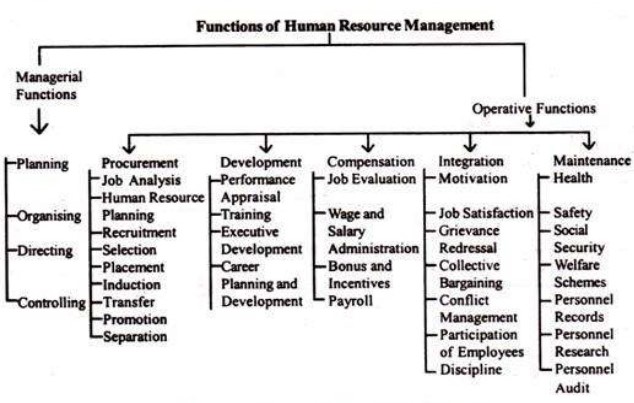
Human resources play a crucial part in organizations from start-ups to established businesses. The functions of human resources can be split into two categories: managerial functions and operative functions. Managerial functions include planning, organizing, directing and controlling. The operative functions are further split into 5 tasks: procurement, development, compensation, integration and maintenance.
The first task: procurement, HR has tasks of job analysis, human resource planning, recruitment, selection, placement, induction, transfer, promotion and separation. Job analysis is “the process of identifying and determining the duties, responsibilities, and specifications of a given job” (Markovska 2020). With the data collected, a job add will be published and the right person will be hired for the role. Completing the HRM job analysis will allow the HR to determine the level of experience. qualifications, skills and knowledge required to complete the job successfully. HR does job analysis using three methods: interview, questionnaire and observation. (Markovaska 2020).
With the interview method, analysts collect information from employees about their tasks and how the are dealing with it. Interviews can be either structured or unstructured.
structured interviews follow a systematic approach where employees are interviewed accurately and consistently, following a preset format. In a structured interview, you typically see that:
- All interviewees are asked the same questions in the same order.
- Interviewers record, compare and evaluate answers against standardized criteria.
- The interview process remains the same even if the interviewer changes.
Structured interviews are more reliable and a higher level of validity.
The cons of using the interview method is that employees may exaggerate on details, hence give a false image of reality. In order to get accurate and reliable results, HR professionals should interview multiple employees from the same position or department.
The second method is creating questionnaires and handing them to employees, supervisors and managers to be filled out. The questionnaire method is the most popular, since it is fast, inexpensive and easy.
Questionnaires used for job analysis collect data about all aspects that influence how a job is completed, including both internal and external factors. These are the most common areas that questionnaires focus on:
- Knowledge, skills, experience, and qualifications
- Duties performed daily
- Duties performed less frequently
- Equipment and materials used for duties
- Time spent on different job duties
- Physical and emotional input
- Level of job satisfaction
- Salary and compensation
- Work conditions
- Additional comments
Using questionnaires is not the best method of gaining reliable results, but nevertheless is a useful method since it can shed light on new issues which were before unnoticed. Other disadvantages include misinterpretation, high non-response rates and innacurate information given by answerers.
The third method is observing employee’s completing their daily duties. Using the observation method, HR professionals are able to observe data first hand in real-life situations, unlike during interview’s where it is set-up. When using the observation method, HR is able to see what the employee does and what does not.
The disadvantages of the method are:
- istortion of information if an employee is aware of the observation.
- Awareness may affect the work output during the observation.
- Not all job duties and reactions can be observed in the set time frame.
- Higher managerial and executive roles may be difficult to observe fully. istortion of information if an employee is aware of the observation.
- Awareness may affect the work output during the observation.
- Not all job duties and reactions can be observed in the set time frame.
- Higher managerial and executive roles may be difficult to observe fully.
The second function is development, which includes performance appraisal, training,executive development, career planning & development.
The third function is compensation, which includes job evaluation, wage & salary administration, bonuses & incentives as well as payroll.
The fourth function is integration, which includes motivation, job satisfaction, grievance redressal, collective bargaining, conflict management, participation of employees and discipline.
The fifth function is maintenance, which includes health, safety, social security, welfare schemes, personnel records, personnel research and personnel audit.
The HR value chain

The HR value chain is based on the work of Paauwe and Richardson in 1997. The value chain can be divided into two categories: HRM activities and HRM outcomes. “HRM activities are day-to-day activities, including recruitment, compensation, training, and succession planning. These activities are often measured using HR metrics. These are so-called efficiency metrics. The cheaper we hire and the faster we train, the better. HRM outcomes are the goals we try to achieve with the HRM activities. We recruit, we train, and we compensate to achieve certain goals/ outcomes. These outcomes include employee satisfaction, motivation, retention, and presence”. (Vulpen 2019).
How can internal processes help a company gain competitive advantage?
How can internal processes help a company gain competitive advantage?
improving customer service, product quality, business efficiency etc.
An organization chart allows you to specify who is responsible for a specific function, and with the process view allows you to answer to the 3 main questions: “who is involved in delivering a product or service, what they do and what changes as a result of their actions” (Workspace 2019). Most small businesses operate in the service industry rather than manufacturing. Due to the nature of the service industry, the quality of the service is graded by what you do and most importantly how well you do it. W.
According to: Edwards Deming, the American, professor, and consultant who drove the quality movement in Japan said: “If you can’t describe what you are doing as a process, you don’t know what you’re doing (E. Deming, in Workspace).
In the competitive service industry, in order to stay in business and gain growth businesses must fully understand and fulfill customer needs better than competitors. This can be analysed and understood by thinking about the business in process terms. (Workspace).
In the late 1990’s businesses began Business Process Re-engineering (PBR), during which in the first movement businesses had a large amount of failed projects due to focusing on purely cutting costs and over ambitious goals and not on e.g. customer demands (workspace).
For small businesses, Workspace argues that for example sole traders usually have specific interests and expertise in a specific field such as marketing and focus mostly on the marketing aspects, and turn a blind-eye to other key aspects such as finance, accounting and sales. In the book ‘The E-myth revisited’ by Michael Gerber, he explains the harsh reality that entrepreneurs who have the technical work don’t necessarily have the skills to successfully operate a business. (Workspace). Gerber created a program which contains seven steps to developing a business’s strategy:
“your primary aim, strategic objectives, management strategy, people strategy, marketing strategy, and lastly systems strategy” (Gerber, in Workspace).
In order to successfully improve your service or product is to view it in the target customer’s perspective. When planning, an entrepreneur should answer these three questions: What roles are involved in delivering your product or service? What do you do at each step? And what changes as a result of your actions? In addition, planning roles which are required in your business, such as customer service, marketing and management. (Workspace).
References
Workspace. Improving your internal processes. URL: https://www.workspace.co.uk/community/homework/growth-and-strategy/improving-your-internal-processes. Accessed: 19 February 2020.
E. Vulpen. 5 Human Resources Models Every HR Practitioner Should Know. URL: https://www.digitalhrtech.com/human-resources-models/. Accessed: 19 February 2020.
Image: Functions of Human Resource Management. http://derickperera.blogspot.com/2018/12/introduction-to-human-resource.html. Accessed 20 February 2020.
The 3 Job Analysis Methods Every HR Professional Needs To Know. M. Markovska 2020. URL: https://blog.careerminds.com/job-analysis-methods. Accessed 23 February 2020.
 Kevin's blog